Ethical Standards
Ethical Standards
Ethical Policies for Publication
Ethical standards for publication are in place to ensure high-quality scientific work, maintain public trust in scientific findings, and ensure individuals receive proper credit for their ideas. It is crucial for readers, writers, reviewers, and editors to follow the ethical rules set by Fringe Global Scientific Press. The ethical policy of Fringe Global Scientific Press guides the selection of research papers or articles that meet the publication criteria for each issue of the Journal. We ensure that Authors, Editors, and Reviewers are informed about best practices in publication ethics. Several policies are in place, and details are given below.
1. Duties and Responsibilities of Publisher / Editors / Reviewers / Authors
1.1 Duties and Responsibilities of Publisher
- Fringe Global Scientific Press is dedicated to upholding the authority of editorial judgments on manuscript submissions as ultimate and conclusive.
- Fringe Global Scientific Press pledges to uphold a commitment to impartiality in the evaluation of manuscript submissions, prioritising professional judgement above any potential financial influences.
- Fringe Global Scientific Press is dedicated to upholding the integrity of academic and research records.
- The ethics of Fringe Global Scientific Press are being monitored by many individuals involved in the publication process, including the Editor-in-Chief, Associate Editors, Editorial Board Members, Reviewers, Authors, and Readers.
- Fringe Global Scientific Press consistently conducts plagiarism and data fraud assessments on all submitted manuscripts.
- Fringe Global Scientific Press demonstrates a consistent willingness to publish necessary revisions, clarifications, and retractions of its publications.
1.2 Duties and Responsibilities of Editors
- The editors of the journal should be able to decide for themselves whether to accept or reject a paper.
- The editors of the journal should keep the papers that are sent in secret while they are being reviewed or until they are released.
- The Editor-in-Chief should make a judgment on whether or not to publish submitted papers in collaboration with other editors and reviewers.
- It is essential for the Editors of the journal to uphold the principle of maintaining the anonymity of reviewers.
- It is essential for the Editors of the journal to declare and make efforts to mitigate any potential conflicts of interest.
- It is essential for the Editors of the journal to uphold academic integrity and make concerted efforts to cater to the requirements of both readers and authors.
- Editors of the journal should be amenable to publishing corrections, clarifications, retractions, and apologies when necessary and willing to investigate instances of plagiarism and fraudulent data.
- The editors of the journal ought to be constrained solely by the realm of intellectual substance.
- The Editors of the journal are obligated to maintain confidentiality and refrain from sharing any details on submitted articles with anybody other than the corresponding author, reviewers, prospective reviewers, other editorial advisors, and the publisher, as deemed appropriate.
- The editor and members of the editorial board will refrain from using unpublished information provided in a submitted work for their own research endeavours unless they have obtained specific written approval from the author.
1.3 Duties and Responsibilities of Reviewers
- The reviewers of the journal are expected to assist the editors in making decisions on the publication of submitted papers.
- It is essential for reviewers to uphold the principle of secrecy while handling manuscripts that have been extended to them for review.
- The reviewers are expected to promptly give constructive comments that will assist the editors in determining whether the submitted paper should be accepted for publication or not.
- The reviewers are obligated to maintain the confidentiality of the paper submitted for peer review. They are prohibited from using the information acquired during the peer review process for personal gain.
- Reviewers should be technical, skilled, and fair in their opinions on each accepted paper.
- Reviewers shouldn't read papers where they have a personal or financial connection to any of the writers, companies or institutions mentioned.
- If the reviewers have a conflict of interest, they should say so and try to stay away from it.
1.4 Duties and Responsibilities of Authors
- When authors submit their manuscripts, they are required to confirm that their articles are free from plagiarism, constitute original work, and adhere to all ethical and publishing policy standards set out by Fringe Global Scientific Press.
- The author must acknowledge that they have not already submitted the paper for publication elsewhere and that they will refrain from submitting it to any other publication throughout the review process.
- Assume all accountability for the work one submits to and publishes with Fringe Global Scientific Press.
- Authors must disclose all potential conflicts of interest in a ‘Conflicts of Interest’ section, explaining why any interest might be a conflict. If there are none, they should state, “The author(s) declare(s) that there is no conflict of interest regarding the publication of this paper.” Submitting authors are responsible for ensuring co-authors declare their interests.
- Authors must disclose current or recent funding (including for article processing charges) and any other payments, goods, or services that could influence the work. All funding, whether it presents a conflict or not, must be acknowledged in the ‘Acknowledgments’.
2. Policy on Authorship and Contributorship
The Authors' list should accurately and clearly mention the corresponding author's details with an email address in the paper at the time of submission. The corresponding author's submission implies that all authors and responsible authorities approved the publication. The list of authors should meet the criteria for the conception and design of the study, data acquisition, or data analysis and interpretation. They should also be involved in drafting the article or critically revising its important intellectual content. Final approval of the version to be submitted is required.
The corresponding author must declare the following details when submitting the article:
- The cover letter should be submitted along with the paper.
- To add, delete, or rearrange author names before acceptance, you must declare the reason for the change and obtain written confirmation by e-mail from all authors, including those who have been added or removed, indicating their agreement with the proposed change.
- Authors cannot alter authorship after publication.
3. Research Integrity
3.1 Article Valuation
All manuscripts undergo peer review and must meet academic standards. If approved by the editor, submissions are reviewed anonymously. Our Research Integrity team may seek external advice on submissions with ethical, security, biosecurity, or societal issues, consulting experts and the academic editor before taking actions like recruiting specialized reviewers, involving extra editors, or declining the submission.
3.2 Plagiarism
Fringe Global Scientific Press uses Turnitin™ similarity checks to detect overlapping or similar text in submitted manuscripts. Authors must not use others' words, images, or ideas without attribution, citing all sources at the point of use. Reuse of wording must be limited, attributed, or quoted. Authors are responsible for ensuring originality. Manuscripts are evaluated for similarity to previous work, and figures are checked for duplication. Detected plagiarism results in rejection (if unpublished) or retraction (if published).
3.3 Submission of Duplicate and Redundant Manuscripts
Manuscripts published or under review elsewhere will be considered duplicate submissions. If authors use their previous work, they must cite it and show how their new manuscript adds novel insights. Reusing words outside the Methods section requires attribution or quoting. Reusing figures or large portions of previous work may require copyright permission, which authors must obtain. Duplicative or redundant publications, where data are republished in different words by the same authors, are not accepted. A single study should not be divided into multiple submissions with similar data and questions across or within journals.
3.4 Conferences and Proceedings
Manuscripts based on conference papers may be allowed but must be expanded to be considered original. Authors should add substantial new content, such as experiments or new analysis of old data, leading to original discussions or conclusions that greatly surpass the conference version. Permission for reuse is required if the copyright isn't owned by the author, with proof needed upon submission. Cite the conference paper.
3.5 Data Fabrication and Falsification
Authors of submitted or published articles found to involve fabricated, falsified, or manipulated results will face sanctions, and their articles will be retracted immediately.
3.6 Territorial Descriptions, Maps & Affiliations
Fringe Global Scientific Press is neutral on territorial descriptions, maps, and author affiliations. Territorial claims are solely those of the authors and do not represent their organizations, the publisher, editors, or reviewers.
4. Citation Policy
Submitted manuscripts with citations mainly to boost author or journal citations will face sanctions. Editors and reviewers must not request references solely to increase citations for authors, journals, or associates. All citations must be genuine; self-citations are strictly forbidden. Authors should avoid excessive self-citation. Manipulation will result in manuscript rejection and possible institutional reporting. Any peer or editor encouragement of such practices should also be reported.
5. Conflicts of Interest
Conflicts of Interest, or "competing interests," refer to situations that might influence the objectivity of research, including personal, financial, intellectual, professional, political, or religious factors. Editors, authors, and reviewers may have conflicts, which Fringe Global Scientific Press aims to identify and mitigate to protect research integrity. All involved in peer review must disclose relevant personal circumstances, associations, and funding sources. Not disclosing conflicts can lead to manuscript rejection. However, conflicts related to public funding from government, charities, or academic institutions do not need to be reported. Conflicts are not permanent; relationships ending over two years before submission do not require disclosure.
Editors-in-Chief and Editorial Board members must declare any conflicts of interest affecting their ability to fairly review or handle an article; if they submit work, they must disclose related activities and relationships. Authors and reviewers should inform the journal of any conflicts or relationships that could hinder impartial evaluation. In such cases, they will be removed from the review process to ensure objective assessments.
6. Investigations and Enforcement Actions
If there are documented violations of any of the policies mentioned above that occur in a journal published by Fringe Global Scientific Press, the following sanctions will apply: immediate rejection of the infringing manuscript and all other submissions by the authors to any Fringe Global Scientific Press journals. Authors are also barred from submitting new work, either alone or with others, for at least 24 months. Additionally, they cannot serve on any Editorial Board of these journals. If violations are particularly egregious, the publisher may impose additional sanctions beyond those described.
7. Errors in Published Works
7.1 Corrections and Retractions
We will not allow corrections after publication of the article on the journal website. In exceptional cases, the Editor-in-Chief will make a decision based on the requests received from the authors. Articles may be withdrawn, retracted, removed, or replaced after publication if they contain substantial errors or ethical violations are found. The Editor-in-Chief leads the investigation and decision on retraction. Once approved, the article is marked 'RETRACTED' but remains accessible on the journal’s website.
7.2 Remarks Following Publication
If a critique raises concerns about a paper's results or methods, it may be published if the concerns are reasonable. The Editorial Office contacts the authors for a response. Critiques and responses are peer-reviewed. If complaints are valid and authors cannot respond adequately, a correction or retraction may occur. Comments should critique the work, not the authors.
8. Peer Review Process
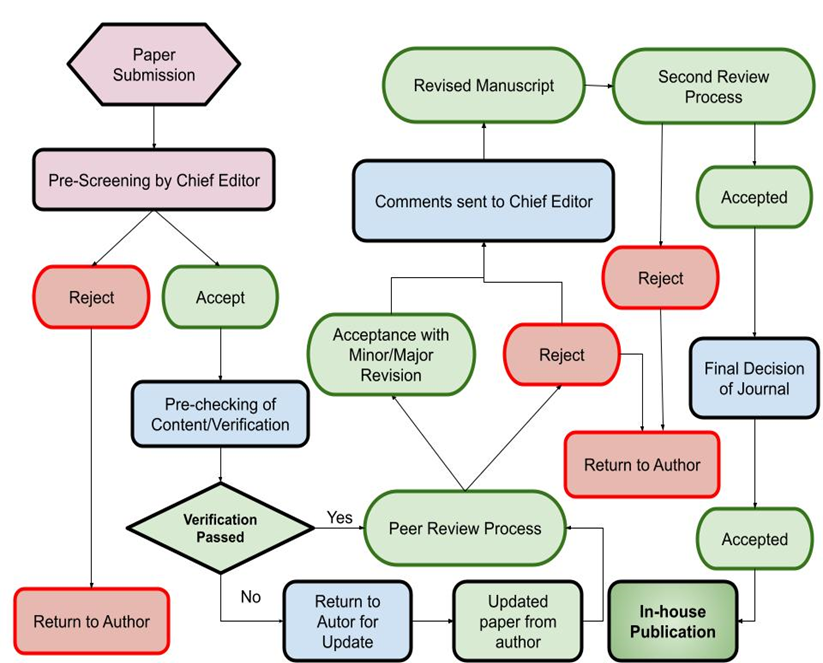
The Fringe Global Scientific Press is dedicated to producing exceptional works that achieve significant literary and policy impact. Every manuscript is carefully selected using a meticulous procedure.
Step 1: Submission
The process begins with the submission of a paper, followed by a round of revisions. The Editors-in-Chief check the manuscript’s conformity with the journal’s scope and quality requirements during pre-screening.
Step 2: Approval and Peer Review
If the Editors-in-Chief approve the manuscript, it proceeds to the peer review stage. Experts in the field conduct an in-depth assessment of the paper's scientific value and contribution to the field. This process involves an integer decision to either:
- Accept the paper as it is.
- Require author modifications (minor or major revisions).
- Reject the manuscript due to insufficient scientific merit.
Step 3: Author Revisions
Based on expert feedback, authors must make the necessary revisions and resubmit the paper for a second round of review.
Step 4: Final Decision
The revised manuscript undergoes another review process. The journal pre-checks and verifies the content before making the final decision to:
- Accept the paper for in-house publication.
- Request further updates before final publication.
If everything is in order, the journal accepts the manuscript for publication, ensuring the highest quality and integrity.
9. Ethical Oversight
All laws and regulations should be followed. Authors must indicate their institution's ethical declarations. Reviewers must maintain the confidentiality of peer review, and not disclose or misuse article information or data.
10. Intellectual Property
All policies related to intellectual property, such as copyright and publishing licenses, are outlined on the journal’s website. Details about publishing costs are listed in the APC. Authors interested in understanding their rights to submit articles to Fringe Global Scientific Press journals can find information on their responsibilities.
11. Ethical Business Practices Policy
11.1 Revenue Sources and Advertising
Fringe Global Scientific Press is an open-access publisher. All revenue from its journals comes solely from Article Processing Charges (APCs) paid by authors whose articles are accepted for publication (there are no submission fees). APCs are waived from 2023 to 2026 for all journals affiliated with Fringe Global Scientific Press.
Fringe Global Scientific Press does not publish advertisements or engage in any direct marketing to generate extra revenue.